
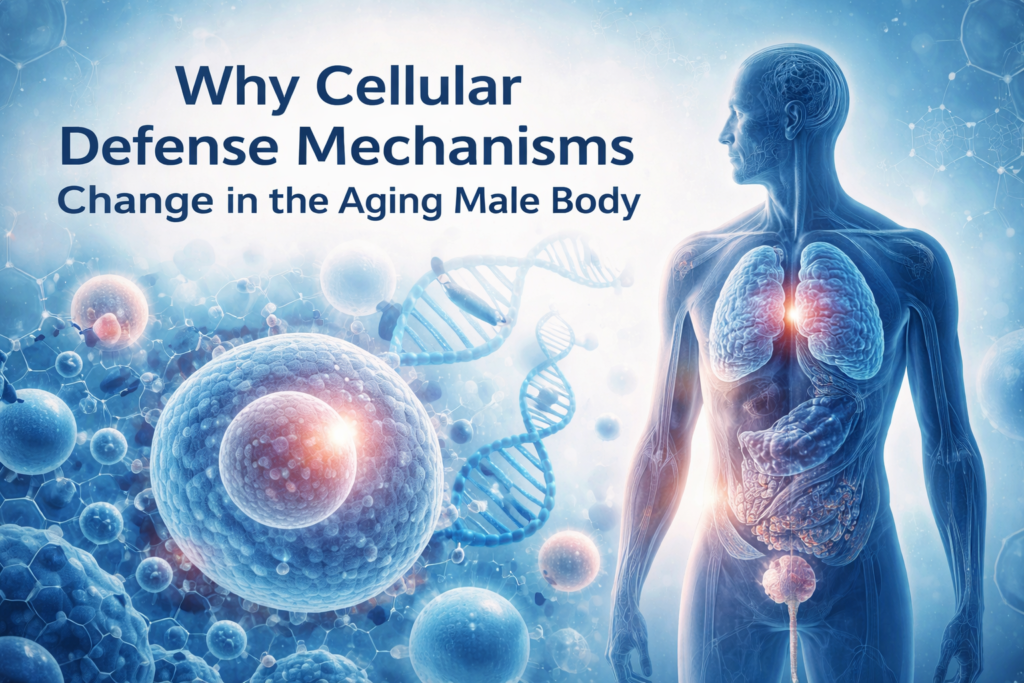
Aging is often described as a visible process — changes in appearance, strength, or energy levels are usually the first things people notice. However, beneath the surface, aging is primarily driven by subtle biological shifts that occur at the cellular level, long before external signs become apparent.
One of the most significant — and least discussed — of these shifts involves the way the male body’s cellular defense mechanisms change over time. Modern research increasingly shows that aging is not simply about “wear and tear,” but about how efficiently cells are able to protect themselves, communicate, and adapt to internal stressors.
Understanding these mechanisms helps explain why certain aspects of male health tend to change with age — and why conventional approaches that focus only on surface symptoms often fall short.
The Body’s Cellular Defense System: An Overview
Every cell in the human body is equipped with protective systems designed to maintain balance, repair damage, and respond to environmental stress. These systems include:
- Antioxidant defenses, which neutralize harmful byproducts of metabolism
- Inflammatory signaling pathways, which coordinate immune responses
- Cell-to-cell communication networks, which regulate growth, repair, and function
In younger individuals, these systems operate with remarkable efficiency. Cells respond quickly to stress, inflammation is tightly regulated, and damaged components are repaired or removed before they cause larger problems.
As men age, however, these protective mechanisms gradually become less efficient — not abruptly, but incrementally, often over decades.
Chronic Low-Grade Inflammation and Aging
One of the most consistent findings in aging research is the presence of chronic low-grade inflammation, sometimes referred to in scientific literature as “inflammaging.”
Unlike acute inflammation — which is a short-term, protective response — chronic inflammation persists quietly in the background. It does not cause immediate pain or obvious symptoms, but it subtly alters the cellular environment.
Over time, this persistent inflammatory state can:
- Disrupt normal cellular signaling
- Reduce tissue resilience
- Interfere with repair and regeneration processes
Importantly, this type of inflammation is not caused by infection or injury, but by gradual changes in immune regulation that occur with age.
Oxidative Stress and Declining Cellular Protection
Another key factor in cellular aging is oxidative stress. During normal metabolism, cells produce reactive molecules known as free radicals. Under ideal conditions, the body’s antioxidant systems neutralize these molecules before they cause harm.
As men age, antioxidant defenses often become less robust. This imbalance allows oxidative stress to accumulate, leading to:
- Structural changes in cells
- Altered gene expression
- Reduced cellular efficiency
Oxidative stress does not damage a single organ in isolation. Instead, it affects tissues throughout the body — particularly those with high metabolic activity or specialized functions.
The Importance of Cellular Communication
Cells do not function independently. They rely on constant communication through chemical signals, enzymes, and molecular messengers. These signals regulate everything from tissue maintenance to hormonal balance.
With age, cellular communication becomes less precise. Signals that once triggered efficient responses may weaken or become distorted. This breakdown can lead to:
- Delayed cellular responses
- Reduced adaptability to internal changes
- Inefficient coordination between tissues
In men, this loss of communication efficiency is increasingly recognized as a central factor in age-related physiological changes.
Why Focusing Only on Symptoms Misses the Bigger Picture
Many conventional approaches to age-related concerns focus on managing visible symptoms rather than understanding the underlying biological shifts. While symptom-based strategies may offer temporary relief, they often fail to address the root processes occurring at the cellular level.
Modern research suggests that long-term health outcomes are closely linked to how well cellular defense systems are supported — particularly those related to inflammation control, oxidative balance, and communication efficiency.
This shift in perspective has led scientists to explore more foundational approaches centered on cellular health rather than isolated symptoms.
Emerging Research and a New Way of Thinking
In recent years, research teams have begun examining how specific nutrients, plant compounds, and naturally occurring molecules interact with the body’s cellular defense systems. Rather than targeting a single pathway, these studies explore how multiple biological processes can be supported simultaneously.
This systems-based approach aligns with what many researchers now believe: that maintaining healthy cellular defenses may play a crucial role in how the male body adapts to aging over time.
Some studies suggest that when cellular communication improves and oxidative stress is better regulated, tissues function more efficiently — even in later stages of life.
Why This Matters More Than Ever
With global life expectancy increasing, men are spending more years navigating the biological realities of aging. Understanding why cellular defense mechanisms change — and how they can be supported — has become an important focus in modern health research.
Rather than viewing aging as an inevitable decline, scientists increasingly see it as a dynamic process influenced by internal biological environments. Small shifts at the cellular level, when accumulated over time, can have meaningful effects on overall function and resilience.
A Deeper Look Into This Mechanism
While this article provides a broad overview, some researchers have gone much deeper into studying how these cellular defense mechanisms function — and what happens when they become less efficient.
In fact, a team of researchers recently compiled a detailed explanation of how age-related changes in cellular protection occur, and how specific natural compounds interact with these processes.
Those interested in exploring this research further can watch a detailed presentation that breaks down this mechanism step by step and explains it in clear, accessible terms.
👉 🎥 Video Overview: Evidence-Based Prostate Support
Final Note
Understanding aging at the cellular level offers a more complete picture of male health — one grounded in biology, not assumptions. As research continues to evolve, so does our understanding of how the body adapts over time, and what it truly means to support long-term cellular function.