
For some men, the change may happen gradually. An erection may become less firm, take longer to develop, or become difficult to maintain. In other cases, the change may appear more suddenly. Understanding the possible factors behind these changes is an important part of understanding erectile health.

Circulation Is Part of the Picture
An erection depends heavily on blood flow. During sexual arousal, blood vessels supplying the penis need to respond appropriately, allowing blood to enter the erectile tissue. The ability to maintain an erection also depends on what happens after that blood enters the tissue.
This is one reason vascular and cardiovascular health are often discussed in connection with erectile function. But circulation is only part of the story.
Our everyday habits can have a meaningful influence on men’s overall well-being. Staying active, getting enough quality sleep, maintaining a balanced diet, and supporting healthy circulation are all important parts of taking care of yourself as you age.
But there is another aspect of men’s health that often receives less attention — one that can also be closely connected to overall vitality, confidence, and quality of life.
There is another structure that deserves attention: the erectile tissue itself.

The Corpora Cavernosa
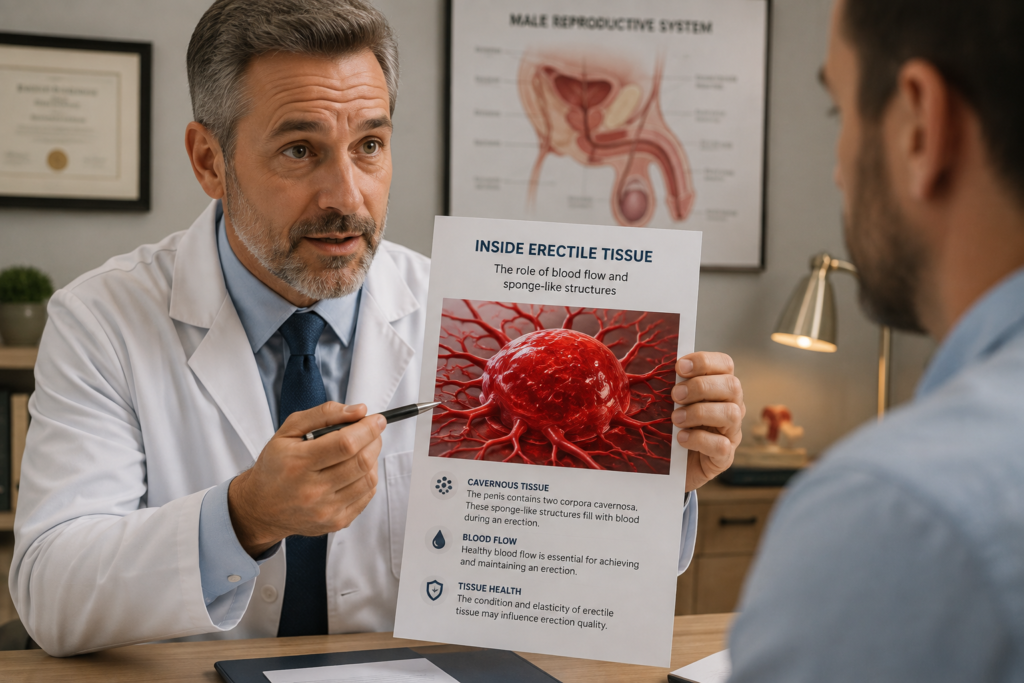
Inside the penis are two specialized structures called the corpora cavernosa. They are made up of erectile tissue containing numerous small spaces that can fill with blood during an erection.
You can think of the structure in a very simple way by comparing it with an ordinary sponge.
A sponge works because its structure contains countless small spaces capable of absorbing and holding liquid. When the structure of a sponge changes over time, its ability to absorb and retain liquid can change as well.
Erectile tissue has a very different biological function, of course, but the comparison provides a useful way to understand an important concept: the physical condition and function of erectile tissue matter.
As men get older, changes in vascular health, circulation and other aspects of erectile tissue may become part of the picture when erection quality changes.
Looking Beyond a Single Cause
This is why erectile dysfunction shouldn’t necessarily be viewed as having one single explanation.
For one person, circulation may be an important factor. For another, medications, hormonal changes, stress, sleep or another underlying health issue may play a role. Sometimes several factors can exist at the same time.
Understanding these different possibilities can provide a more complete picture of why an erection may become less firm, why maintaining an erection may become more difficult, or why sexual function can change over time.
And it raises an interesting question:
What exactly happens inside erectile tissue as erection quality changes?
Understanding the relationship between blood flow, erectile tissue and the structures involved in an erection may provide another perspective on a problem that affects many men.
If you would like to explore this subject further and learn about an approach presented specifically around erectile tissue and erection quality, you can watch the presentation below.

This information is intended for educational purposes and is not a substitute for medical advice. If you are experiencing persistent or new changes in erectile function, consider discussing them with a qualified healthcare professional.