
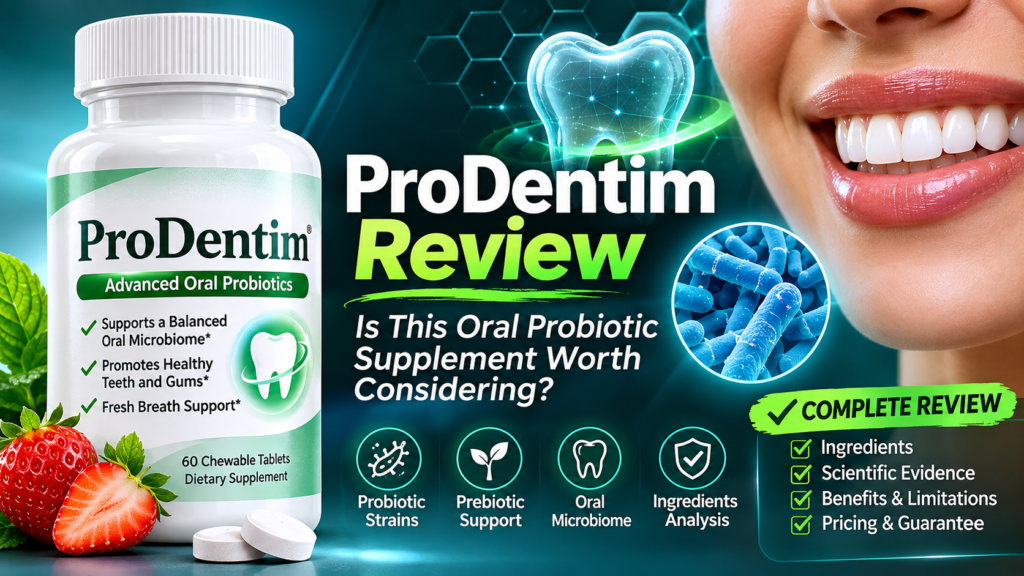
An independent look at its ingredients, oral microbiome claims, scientific evidence, pricing, and limitations.
Quick Overview
ProDentim is a chewable probiotic dietary supplement marketed to support oral health. Its formula is built around a combination of probiotic microorganisms and additional ingredients intended to support the oral microbiome.
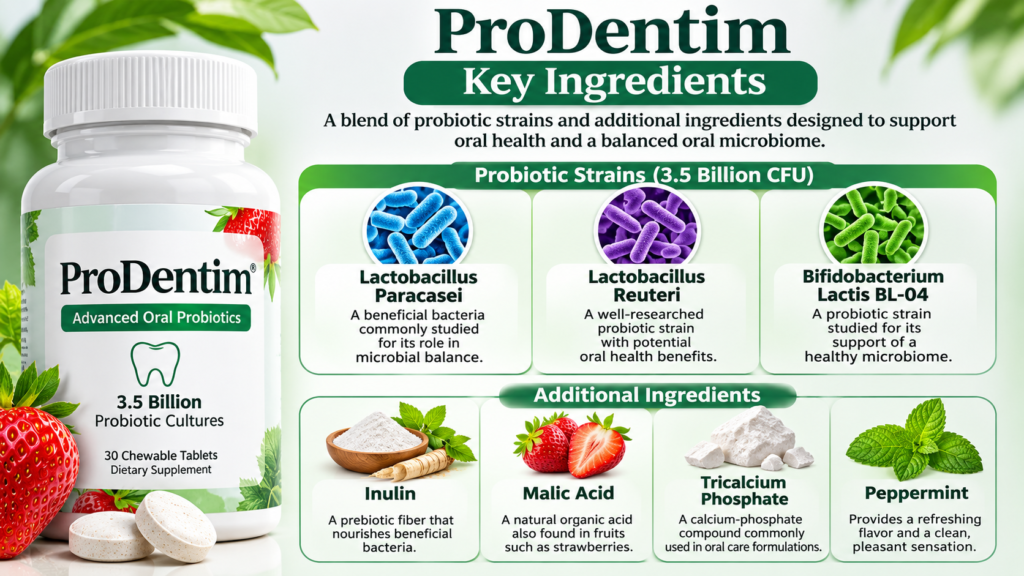
The product’s sales presentation highlights a total of 3.5 billion probiotic cultures and identifies three main probiotic strains:
- Lactobacillus paracasei
- Lactobacillus reuteri
- Bifidobacterium lactis BL-04
It also lists inulin, malic acid, tricalcium phosphate, and peppermint as additional ingredients.
But does the scientific research support the product’s claims? And is the formula itself backed by clinical studies?
We examined the product presentation, its listed ingredients, available scientific literature, and the purchasing options to provide a more balanced assessment.
ProDentim at a Glance
| Feature | Product information |
|---|---|
| Product type | Chewable probiotic supplement |
| Main focus | Oral microbiome support |
| Probiotic count | 3.5 billion CFU, as advertised |
| Main probiotic strains | L. paracasei, L. reuteri, B. lactis BL-04 |
| Additional ingredients | Inulin, malic acid, tricalcium phosphate, peppermint |
| Product format | Chewable tablet |
| Money-back guarantee | 60 days, according to the sales page |
| Available packages | 2, 3, and 6 bottles |
Product information is based on the sales material reviewed. Consumers should verify the current product label and terms before ordering.
1. What Is ProDentim?
ProDentim is a dietary supplement designed around the concept of the oral microbiome.
The oral microbiome refers to the community of microorganisms naturally present in the mouth. These microorganisms interact with one another and with the surrounding environment, including saliva, teeth, gums, and oral tissues.
Not all bacteria are harmful. A balanced microbial community is part of normal oral ecology.
ProDentim is marketed as a way to support this balance through a combination of probiotic microorganisms and other ingredients.
Unlike conventional toothpaste or mouthwash, which are used directly as part of oral hygiene, ProDentim is presented as a chewable supplement.
The manufacturer promotes it as an additional component of an oral wellness routine.
An important distinction: A supplement intended to support oral health is not a replacement for brushing, flossing, professional dental cleaning, or treatment recommended by a dentist.
2. Understanding the Oral Microbiome
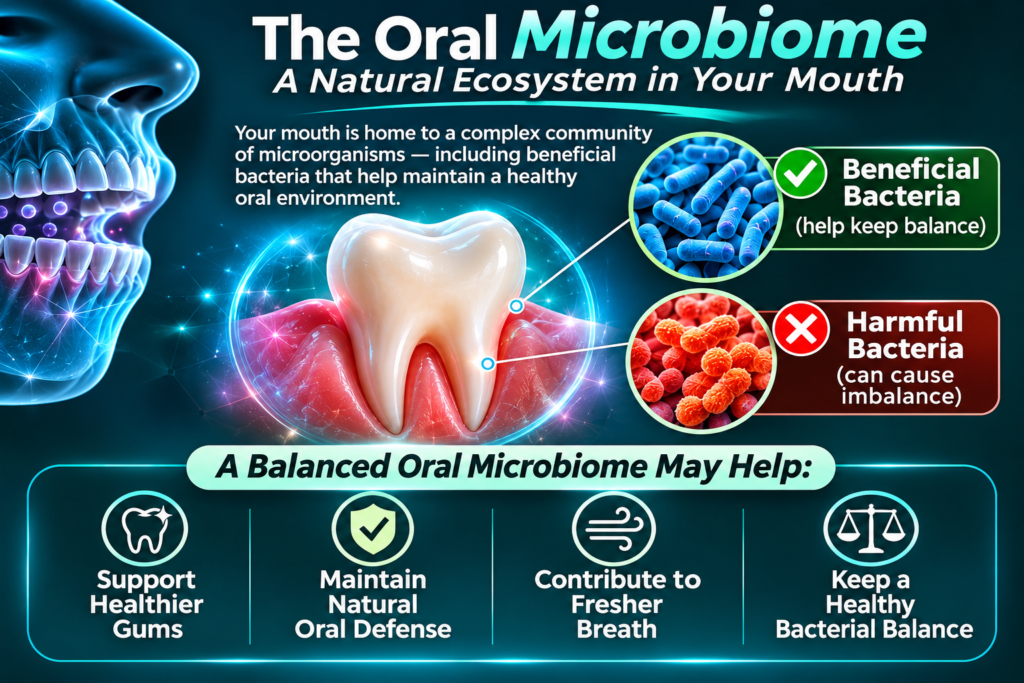
The mouth is home to a complex ecosystem of microorganisms.
Different bacterial communities inhabit the tongue, teeth, gums, and other oral surfaces. Their composition can be influenced by diet, oral hygiene, saliva, lifestyle, and other factors.
The balance of these microorganisms is relevant to oral health.
This is one reason researchers have become interested in probiotics: certain beneficial microorganisms may influence the microbial environment in which they are introduced.
However, the effects of probiotics are not universal. They depend on the specific microorganism, strain, amount, formulation, and intended outcome.
This distinction matters when evaluating a supplement such as ProDentim.
A probiotic strain studied in a laboratory or clinical trial does not automatically establish that every product containing that strain will produce the same result.
3. ProDentim Ingredients: What’s Inside?
According to the product presentation, ProDentim combines three principal probiotic strains with four additional ingredients.
Let’s examine each component and distinguish its general scientific background from what has actually been demonstrated for the finished product.
Lactobacillus paracasei
Lactobacillus paracasei is a bacterial species used in different probiotic formulations.
Research into Lactobacillus species has explored their interactions with microbial communities and their possible role in maintaining a balanced environment.
However, probiotic effects are strain-specific. Evidence involving one L. paracasei strain cannot automatically be applied to every strain of the same species.
The product presentation does not provide enough detail to independently establish the specific clinical evidence associated with the exact strain used.
Lactobacillus reuteri
Lactobacillus reuteri is one of the more frequently studied probiotic species in oral and gastrointestinal research.
Some clinical studies have investigated particular L. reuteri strains as an adjunct to conventional periodontal treatment.
A 2024 systematic review examined clinical studies involving L. reuteri in people with chronic periodontitis. The research explored outcomes such as periodontal pocket depth, clinical attachment levels, and bleeding on probing.
These findings are relevant to the broader scientific discussion of oral probiotics, but they do not establish that ProDentim itself produces the same outcomes.
The specific strain, dose, formulation, and treatment protocol all matter.
Bifidobacterium lactis BL-04
Bifidobacterium lactis BL-04 is another probiotic microorganism listed in the product presentation.
Research involving B. lactis strains has examined different aspects of microbial balance and immune-related functions.
However, research conducted on a particular strain or application should not be interpreted as proof that the same benefits occur in the oral cavity when consuming a finished supplement.
For ProDentim, the presence of BL-04 is a formulation detail, not independent proof of a specific dental benefit.
Inulin
Inulin is a type of dietary fiber commonly used as a prebiotic ingredient.
Prebiotics are substances that can be utilized by microorganisms in ways that may provide a health benefit.
Inulin is frequently included in formulations intended to support beneficial microbial populations.
Its presence in ProDentim is consistent with the product’s probiotic-and-prebiotic positioning.
However, the effect of inulin depends on the amount consumed and the context of the overall formulation. The product presentation does not establish a specific clinical outcome attributable to the finished supplement.
Malic Acid
Malic acid is an organic acid naturally found in several fruits.
It is used in food formulations and can contribute to flavor and acidity.
The ProDentim sales material associates malic acid with strawberries and tooth appearance.
That marketing description should not be interpreted as proof that consuming ProDentim whitens teeth or produces a clinically measurable whitening effect.
Tricalcium Phosphate
Tricalcium phosphate is a calcium-phosphate compound used in different food, dental, and formulation applications.
Calcium and phosphate are important components of mineralized dental tissues.
Nevertheless, the presence of tricalcium phosphate in a dietary supplement does not demonstrate that the product rebuilds enamel or reverses tooth damage.
Those are much stronger claims than the ingredient information alone can support.
Peppermint
Peppermint is commonly used for flavor and its characteristic cooling sensation.
It is also frequently associated with fresh-breath products.
A pleasant mint flavor or cooling sensation should not be confused with evidence of long-term control of the microorganisms responsible for oral malodor.
Ingredient Summary
| Ingredient | General scientific context | What remains unproven about ProDentim |
|---|---|---|
| L. paracasei | Probiotic research | Specific product-level oral benefits |
| L. reuteri | Studied in periodontal research | Equivalent effects from ProDentim |
| B. lactis BL-04 | Probiotic research | Specific dental outcomes |
| Inulin | Prebiotic fiber | Clinical effect at the product’s dose |
| Malic acid | Food and formulation ingredient | Measurable tooth whitening |
| Tricalcium phosphate | Calcium-phosphate compound | Enamel repair from this supplement |
| Peppermint | Flavoring and cooling ingredient | Lasting control of oral odor |
Our assessment: The ingredient combination is consistent with the product’s oral-probiotic concept. However, ingredient-level research should not be confused with clinical proof of the complete formula.
4. What Does Scientific Research Say About Oral Probiotics?
Interest in oral probiotics has increased as researchers investigate the relationship between microbial communities and periodontal health.
Some systematic reviews have reported potentially favorable results when probiotics are used alongside conventional periodontal treatment.
For example, a 2024 systematic review and network meta-analysis published in BMC Oral Health evaluated 33 studies involving 1,290 participants.
The researchers investigated the use of probiotics alongside professional mechanical plaque removal and periodontal treatment.
The analysis reported improvements in certain periodontal measurements for some probiotic interventions.
This is an interesting area of research, but it requires careful interpretation.
The studies evaluated different probiotic interventions, strains, doses, and treatment protocols. They did not establish that every oral probiotic supplement has the same effects.
A separate 2024 systematic review also examined L. reuteri as an adjunct in the management of chronic periodontitis.
Together, these publications provide scientific context for studying probiotics in oral health.
They do not prove that ProDentim prevents cavities, treats gum disease, restores damaged enamel, or replaces dental care.
What Is the Evidence Level?
| Research area | Our assessment |
|---|---|
| Oral microbiome research | Established research field |
| Probiotics and periodontal health | Promising but heterogeneous evidence |
| Specific probiotic strains | Evidence varies by strain and application |
| ProDentim’s complete formula | Product-specific clinical evidence not established by the material reviewed |
| Replacing conventional dental care | Not supported |
The distinction between research on individual ingredients and research on the finished product is essential.
A product-specific, well-designed clinical trial would provide stronger evidence about the actual formula, dosage, and intended use.
5. What Are the Potential Benefits of ProDentim?
The manufacturer presents ProDentim as a supplement intended to support teeth, gums, and the oral microbiome.
Based on the product concept and the broader research into probiotics, the following are the areas most relevant to its positioning.
Oral microbiome support
The combination of probiotic microorganisms and a prebiotic ingredient reflects an approach intended to support microbial balance.
Gum health research
Certain probiotic strains have been studied as complementary interventions in periodontal research. This does not establish that ProDentim treats gum disease.
Daily convenience
The chewable format may be convenient for people who prefer a chewable supplement rather than a capsule.
Fresh-breath positioning
The product includes peppermint and is marketed in connection with oral freshness. However, lasting breath improvement from the complete formula has not been independently established.
These are potential areas of interest, not guaranteed results.
6. What Are the Limitations?
An independent review should also examine what a product does not establish.
There are several limitations worth considering before purchasing ProDentim.
1. Limited product-specific evidence
The sales material includes scientific references concerning ingredients and probiotics, but does not provide a clinical trial demonstrating the effectiveness of the complete finished formula.
2. Strain-specific evidence matters
Probiotic research is highly dependent on the precise strain. Evidence for one microorganism cannot automatically be transferred to another strain of the same species.
3. Proprietary blend transparency
The sales presentation identifies the main ingredients and the total probiotic count, but does not provide a complete breakdown of the amount of each component in the blend.
This makes it harder to compare the formulation with specific clinical research.
4. Supplements are not dental treatments
ProDentim should not be viewed as a treatment for cavities, periodontal disease, tooth infections, or other dental conditions.
5. Individual responses may vary
The effects of probiotic supplements can differ depending on the individual, formulation, and other factors.
Anyone with an existing dental problem should seek professional dental advice rather than relying on a supplement.
7. ProDentim Pricing and Available Packages
The sales presentation reviewed for this article lists three main purchasing options.
| Package | Total price | Price per bottle |
|---|---|---|
| 2 bottles | $158 | $79 |
| 3 bottles | $207 | $69 |
| 6 bottles | $294 | $49 |
The six-bottle package offers the lowest advertised price per bottle.
The sales page also advertises:
- A 60-day money-back guarantee.
- Free shipping on selected packages.
- Promotional bonuses on the larger package.
Prices, shipping terms, bonuses, and availability may change. Always check the official order page for the current terms before purchasing.
Is the Larger Package Better Value?
From a price-per-bottle perspective, the six-bottle option is the least expensive.
However, purchasing a larger quantity is not automatically the best decision for every consumer.
Consider your budget, the product’s current terms, the guarantee conditions, and whether the product is appropriate for your circumstances.
8. Pros and Cons
Potential Advantages
- Combines probiotic and prebiotic ingredients.
- Includes several microorganisms that have been studied in probiotic research.
- Chewable format.
- Straightforward product presentation.
- Multiple package options.
- Advertised 60-day money-back guarantee.
Limitations
- The complete formula’s clinical effectiveness has not been established by the material reviewed.
- The individual probiotic strains are not fully characterized in the sales presentation.
- The quantities of individual ingredients in the proprietary blend are not clearly disclosed.
- The product should not replace conventional dental care.
- Some of the marketing language goes beyond what ingredient-level research alone can establish.
9. Is ProDentim Worth Considering?
ProDentim is an interesting product because it is built around a subject that has attracted legitimate scientific interest: the relationship between probiotics and the oral microbiome.
Its formula includes probiotic microorganisms, a prebiotic ingredient, and additional components commonly used in food and supplement formulations.
The broader scientific literature suggests that certain probiotic interventions may have potential as complementary approaches in periodontal care.
However, there is an important distinction between promising research and proven product effectiveness.
Based on the information reviewed, we would not describe ProDentim as a clinically proven treatment for dental or gum conditions.
For consumers interested in oral probiotics, it may be worth examining the formulation, label transparency, price, and current purchase conditions before making a decision.
Our recommendation is to approach it as a dietary supplement that may complement an oral wellness routine, not as a replacement for professional dental care.
The bottom line: ProDentim has an identifiable formulation and an interesting scientific concept behind it. Its strongest selling point is its probiotic-oriented approach, while its main limitation is the lack of product-specific clinical evidence presented in the sales material.
10. Frequently Asked Questions
What is ProDentim?
ProDentim is a chewable dietary supplement marketed to support oral health through a combination of probiotic microorganisms and additional ingredients.
How many probiotics does ProDentim contain?
The sales presentation advertises 3.5 billion probiotic cultures per serving.
What are the main probiotic strains?
The product presentation lists Lactobacillus paracasei, Lactobacillus reuteri, and Bifidobacterium lactis BL-04.
Does ProDentim cure gum disease?
There is no sufficient product-specific evidence in the material reviewed to establish that ProDentim cures or treats gum disease. It should not replace professional dental treatment.
Does ProDentim whiten teeth?
The sales presentation associates malic acid with tooth appearance, but this does not establish that the finished supplement produces a clinically proven whitening effect.
Can ProDentim replace toothpaste or mouthwash?
No. A dietary supplement should not replace brushing, flossing, or other dental hygiene practices recommended by a dental professional.
How much does ProDentim cost?
The sales material reviewed lists packages starting at $158 for two bottles, $207 for three bottles, and $294 for six bottles. Current prices should be verified on the official order page.
Does ProDentim offer a money-back guarantee?
The sales presentation advertises a 60-day money-back guarantee. Consumers should read the current terms and conditions before ordering.
Who should consult a healthcare professional before using probiotics?
People with serious underlying illnesses, weakened immune systems, or other relevant medical circumstances should seek professional advice before using probiotic supplements. The NIH Office of Dietary Supplements provides additional information about probiotic safety.
Final Editorial Verdict
ProDentim is an oral probiotic supplement with an identifiable formulation and a concept supported by an active area of scientific research.
However, the evidence available for probiotic ingredients should not be mistaken for proof that the finished product delivers all the benefits described in its marketing.
We consider transparency, realistic expectations, and professional dental care essential when evaluating products in this category.
ScientificVanguard’s assessment: ProDentim is worth examining as an oral-probiotic supplement, but consumers should make their decision with a clear understanding of the current evidence and its limitations.
Explore the Official ProDentim Offer
If you have reviewed the ingredients, limitations, and purchasing options and would like to examine the manufacturer’s current offer, you can consult the official product page below.
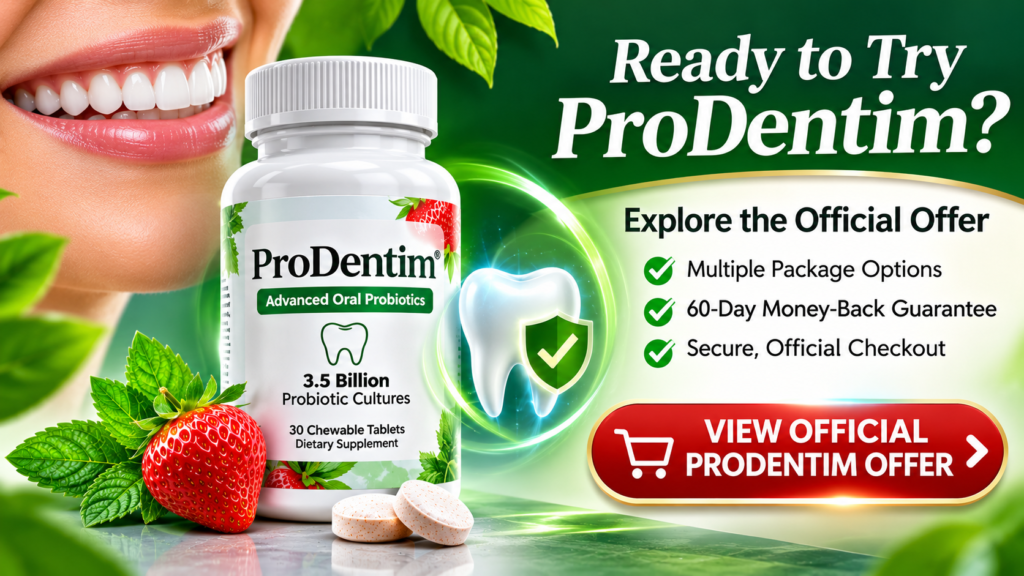
Check current pricing, package options, shipping conditions, and the complete refund policy before ordering.
Editorial Disclosure
ScientificVanguard may receive a commission if a reader purchases a product through links in this article. This does not increase the price paid by the consumer.
Our editorial analysis aims to distinguish product marketing statements from independently published scientific evidence. Affiliate relationships do not determine our conclusions.
Health Disclaimer
This article is for informational and educational purposes only. It is not medical or dental advice and does not diagnose, treat, cure, or prevent any disease.
Dietary supplements are not substitutes for professional dental care. Consult a qualified healthcare or dental professional regarding questions about your oral health or the use of dietary supplements.
Sources and Further Reading
- Office of Dietary Supplements, NIH — Probiotics: Fact Sheet for Consumers
- Mendonça et al. (2024) — Probiotics in the non-surgical treatment of periodontitis: a systematic review and network meta-analysis, BMC Oral Health
- Ram et al. (2024) — Clinical effects of Lactobacillus reuteri probiotic in chronic periodontitis: a systematic review
- FDA — Is It Really ‘FDA Approved’?
- FDA — Dietary Supplement Labeling Guide: Claims
Last reviewed: November 2026